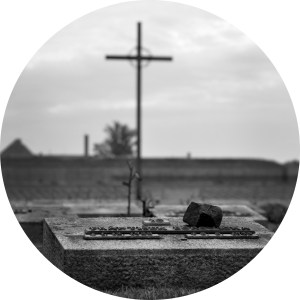
I bade farewell to the gray, water-laden sky as I ducked into the catacomb like corridor. It seemed like at any moment the Heavens might burst forth with tears… and so might I. Deeper into the darkening, bone-chilling cavern I ventured.
Terezín, or Theresienstadt in German, is a former military fortress in the southern part of the Czech Republic that was erected in the late 18th century by the Habsburg Monarchy. When it was determined that the fortress was not strategically located for battle, the complex developed into a sort of political prison during the first World War. With the beginning of World War II atrocities, the underutilized military base soon became a ghetto for housing Jews. Gas chambers and mass execution techniques were not utilized at the facility and the compound was instead considered a retaining area before the Jews were sent to other death camps. Even though extermination was not Terezín’s function, massive overcrowding led to extremely high death tolls in the camp. Terezín was designed to hold 5,655 occupants during peacetime and about 11,000 in times of war. In 1942, starvation and disease swept through the camp as the population climbed to over 60,000. Beneath the camp is a massive underground web of corridors and chambers which I had the opportunity to explore.
Each step forward into the hollow cave was like a step back in time and a step closer to understanding the desperation and despair that was prevalent among the crowded inhabitants…..
The clunk of the Gestapo police officer’s heavy boots deaden against the frozen walls. His orders echo in his mind as he finishes wrapping up the last meager slices of bread that remained from the inmates’ dinner. “Uberwatchen.” Watch closely. The Gestapo considers how two have already escaped and how the Commander does not want the others to think there is hope. There is no hope.
Rubber squeaks on stone as the police officer pivots around a corner and peeks through one of the holes in the confining stone wall just in time to see a moonlit, ghostly outline padding through the thistle brush toward the exterior of the camp. The well-trained Gestapo strides to an opening in the wall and with expert timing, flings out his arm to drag the potential escapee inside the corridor. Too weak to resist or protest, the boy collapses at the Gestapo’s feet in a trembling heap. With a fire in his soul, the soldier lugs the boy to the end of the tunnel. After a quick glance over his shoulder the officer grabs the boy’s frail frame and locks in on his hollow, sunken eyes – the exasperation is palpable as the boy chokes for even a thin breath through the air fraught with fear. As the Gestapo draws his knife he knows it must be done quickly, precisely and secretly.
Without another word, the Gestapo drives the boy toward the moonlight archway and points to the low, crumbling part of the wall that holds the promise of freedom. “Gott mit dir gehen,” the solider whispers, gingerly handing his blade over to the Nazis’ captive. God go with you.
I peeked out of the tunnel – into the sunlight and back into reality. Surprisingly, a smile crept across my face for there is always hope.
 A Jacket's Journey