I closed the door to my North Avenue apartment quietly behind me and draped my weekend luggage across my body like ornaments on a Christmas tree. With my backpack, my suitcase, my camera bag, and my purse, I clattered toward the elevators as quietly as possible, trying not to wake my weary Georgia Tech hall mates who were surely resting this early on a Saturday morning. As I neared the end of the hallway, I heard someone call my name in a hoarse whisper. Turing around I saw Maria Samuel and Kelsey Roberts waving excitedly and clomping down the hall in a similar fashion.
We are all a part of the Georgia Tech President’s Scholars Program, and our second year class was having a winter retreat to Chattanooga, Tennessee. Opportunities to spend time with my classmates had already become far too few after only a year and a half at Tech, and I was thrilled to catch up with some of my good friends. The retreat would also give our group the opportunity to explore and share ideas about “social justice and community service.” Our brigade expanded as we headed toward the Ford Earth, Science, and Technology building about three quarters of a mile across campus. When we entered the auditorium for a pre-departure briefing and our first session of the morning, excited chatter filled the air! Lara Tucci, Sid Sinha, Carah Stark, Trey Sides… and countless others were already there exchanging warm hugs and friendly words. Although I had at first been reluctant to forgo a weekend of much-needed repose and fun on one of the many fraternity formals that occupied weekends during this time of year, I was already reaffirmed that I had made the right choice by attending the second year PS retreat.
Our weekend had been entirely student-planned, and I was thankful for the work that David McCandless, Karthik Nathan and Josh Price had dedicated to help us enjoy the experience. They had even managed to secure an early morning presentation from the illustrious Sarah Perkins, Coordinator of the Office of Leadership and Civic Engagement! Sarah is well-known across campus for her positive attitude, caring heart, and dedication to serving others. I am very fortunate to work with her through Georgia Tech’s Alternative Service Breaks program and I can attest first hand to how much she has done for me personally, for our organization, and for the Georgia Tech and the Atlanta community as a whole.
Sarah began by encouraging us to appreciate and learn from the new experiences and personal differences we would encounter throughout the remainder of our weekend. With the game “this or that” Sarah illustrated her point by posing questions like, “vanilla or chocolate?” All of us would then scatter to one side of the room or the other depending on our initial reaction and preference. The questions soon became more serious, progressing to inquiries like “passion or commitment?” and “knowledge or power?” It was shocking to see the differences within our group, however it was enlightening to visualize how people with such diverse views can come together in friendship and cooperation.
Next, we all sat solemnly while Sarah shared with us this excerpt from the book “Walking With the Wind” by John Lewis:
“On this particular afternoon – it was a Saturday, I’m almost certain – fifteen of us children were outside my aunt Seneva’s house, playing in her dirt yard. The sky began clouding over, the wind started picking up, lightning flashed far off in the distance, and suddenly I wasn’t thinking about playing anymore; I was terrified. I had already seen what lightning could do. I’d seen fields catch on fire after a hit to a haystack. I’d watched trees actually explode when a bolt of lightning struck them, the sap inside rising to an instant boil, the trunk swelling until it burst its bark. The sight of those strips of pine bark snaking through the air like ribbons was both fascinating and horrifying.
Lightning terrified me, and so did thunder. My mother used to gather us around her whenever we heard thunder. And she’d tell us to hush, be still now, because God was doing his work. That was what thunder was, my mother said. It was the sound of God doing his work.
But my mother wasn’t with us on this particular afternoon. Aunt Seneva was the only adult around, and as the sky blackened and the wind grew stronger, she herded us all inside.
Her house was not the biggest place around, and it seemed even smaller with so many children squeezed inside. Small and surprisingly quiet. All of the shouting and laughter that had been going on earlier, outside, had stopped. The wind was howling now and the house was starting to shake. We were scared. Even Aunt Seneva was scared.
And then it got worse. Now the house was beginning to sway. The wood plank flooring beneath us began to bend. And then, a corner of the room started lifting up.
I couldn’t believe what I was seeing. None of us could. This storm was actually pulling the house toward the sky. With us inside it.
That was when Aunt Seneva told us to clasp hands. Line up and hold hands, she said, and we did as we were told. Then she had us walk as a group toward the corner of the room that was rising. From the kitchen to the front of the house we walked, the wind screaming outside, sheets of rain beating on the tin roof. Then we walked back in the other direction, as another end of the house began to lift. And so it went. Back and forth, fifteen children walking with the wind, holding that trembling house down with the weight of our small bodies.
More than half a century has passed since that day, and it has struck me more than once over those many years that our society is not unlike the children in that house, rocked again and again by the winds of one storm or another, the walls around us seeming at times as if they might fly apart.
It seemed that way in the 1960s, at the height of the civil rights movement, when America itself felt as if it might burst at the seams – so much tension, so many storms. But the people of conscience never left the house. They never ran away. They stayed, they came together and they did the best they could, clasping hands and moving toward the corner of the house that was the weakest.
And then another corner would lift, and we would go there.
And eventually, inevitably, the storm would settle, and the house would still stand.
But we knew another storm would come, and we would have to do it all over again.
And we did.
And we still do, all of us. You and I.
Children holding hands, walking with the wind. That is America to me – not just the movement for civil rights but the endless struggle to respond with decency, dignity and a sense of brotherhood to all the challenges that face us as a nation, as a whole.”
What Sarah shared was SO powerful. We broke into small groups where we discussed the excerpt in detail, sharing childhood memories that helped us or hindered us, who we admired as “people of conscience,” and the what we saw as the “weakest corners” of society and how we could effectively address those weak spots.
Finally, Sarah concluded by urging us to open our minds so that we could grow in our understanding of the retreat’s themes – social justice and community service.
My brain already felt stretched further than it had been in months – and that’s saying something for a Georgia Tech student! Excited about what we would learn over the next two days, we flung our belongings beneath the bus and hopped aboard for a pleasant journey to Chattanooga!
After dropping our luggage at the hotel, we quickly boarded the bus again for trip to David’s high school where he had prepared an activity for us. As the bus lurched down the steep hill outside our accommodations, the disconcerting screech of metal on asphalt brought our progress to a standstill. The bus was stuck. The back fender had caught against the ground, leaving the back wheels practically suspended and unable to regain traction.
In minutes, Ryan Simpson became a stand in traffic director, Karthik was speaking with a man who had stopped nearby to see if he could assist, David was on the phone with the bus agency, Bradley Smith had headed outside to see if a little elbow grease could dislodge the vehicle, Joe Boltri was consoling the driver, and the remainder of us had begun a lively discussion of comparative religions at the back of the bus. It was our PS class at its finest!
While we waited for assistance, the leaders decided to improvise – we would complete the activity in the hotel parking lot instead of at David’s high school, then we would be able to head straight to downtown Chattanooga for dinner.
The exercise essentially created an environment in which, using different colored poker chips, every individual was randomly assigned a certain “value” in an imaginary society. This point value was not explicitly revealed to any other individual throughout the course of the game. During each timed round individuals were given the opportunity to trade chips in hopes of creating combinations that netted a higher point value.
I soon realized that I had been dealt an unfortunate hand. I was unable to make any favorable trades no matter how hard I tried! I coped with this unlucky circumstance by shutting down completely. I refused to even attempt trading. Others who had received the same point value as me resorted to conning individuals with higher value chips by entering into a trade by offering one color chip, but ultimately handing over another color chip entirely. At the end of each round, we were segregated by point value into “classes.” Each group was then given three tennis balls, each representing a very high point value. These tennis balls, by consensus of the group, could be distributed among the group members in any combination.
In the lowest value group, we continually decided to offer the tennis balls to a single player who had the highest value within our class, hoping that we could collaboratively catapult them to the upper class, and hoping that they would remember how we had helped them once they reached the pinnacle of the imaginary society. Additionally, the upper class was allowed to make a single, unrestricted rule at the end of each round.
Without fail, each round the upper class attempted to make rules that maintained and strengthened their exclusivity. And unfortunately, even when the individuals whom the lower class had pooled their resources to help reach the upper class, the least valued class was never remembered favorably. A middle class also existed. They remained relatively neutral during the entire game and distributed their tennis balls evenly to maintain their population. There was very little movement between classes thought the entire game.
Tension peaked when I, as a member of the lowest class, started a physical movement of our group toward the upper class, who stood on the other side of the parking lot. As we began our “revolution” to take their tennis balls for ourselves, they became outwardly upset and frightened. They began holding out their hands toward us, clinging to their tennis balls as they backed away in a pack, and yelling at us to stay away. The profound effect the game had had on our minds stopped me in my tracks. With that, we ended the game and began our reflection.
Many conclusions can be drawn from this game, and the exercise yielded a powerful discussion of classism, types of government and governmental roles, the value of money, and many other interesting social issues.
Still moved by the power of the activity we had just completed, we headed into downtown Chattanooga. Our discussion of social justice and community service continued over dinner, then David was kind enough to give us a short walking tour of the city. We wandered across starlit bridges, next to imposing historical museums, and through cobblestone streets where climbing ivy clung to brick buildings. Our tour ended in Rembrandt’s Coffee house where we all enjoyed exotic teas and coffees, delicate pastries, and the company of good friends.
The next day, a small group of us visited the Basilica of St. Peter and Paul for Mass before meeting the rest of the group at Lookout Mountain, where we spent some time enjoying the Tennessee wilderness. We talked and laughed as we wandered through the forest paths. At one point our scholarship director even scaled a huge boulder near the side of the path as we all chanted “Chaffee, Chaffee, Chaffee!” – proud and thankful for the wise, caring mentor with which we have been blessed.
After our woodland exploration, we headed to the McCallie School for a presentation by the Women’s Fund of Greater Chattanooga. Through a difficult but necessary discussion of human sex trafficking, the well-spoken women helped us further explore and reflect on the topics of social justice and community service before we headed home.
We returned to campus late Sunday night, but our retreat was not yet concluded. We would put into practice what we had learned over the course of the retreat by participating in a community service project on Martin Luther King Jr. Day.
Early Monday morning I stumbled from my bed and toward my car. I drove a few miles up the highway to Howell Mill Road, where I loaded down the back of my car with seventy fresh Chick-fil-A chicken biscuits. My steaming cup of coffee and the aroma of the breakfast roused me as I drove back toward campus to rendezvous with the remaining second years that had been on the retreat. I was ready for MLK Day of Service!
We caravanned to National Divine Church, located in the heart of Atlanta’s “Sweet Auburn District.” The sidewalk in front of the church was dusty and cracked, the wooden boards on the face of the building were weathered and chipped, and weeds and brush had sprouted up all along the base of the foundation. Inside the church, the floorboards were warped and squeaky as we walked up the narrow, steep staircase. Although the church was time-weathered and in need of repair, it was still a beautiful building with glowing stained glass windows and a welcoming atmosphere. Although the church building itself was not large and flashy, the members of the congregation that stood waiting to welcome us were humble, sincere, and proud.
It wasn’t long before our Georgia Tech crew had joined about twenty other volunteers who lived and worked in the area. While everyone happily munched on the biscuits, I sought out our volunteer point of contact – Pastor Bobby L. Graham.
Although I had communicated with “Revered Bobby,” as he preferred to be called, over email, I had yet to meet him in person. After just minutes of exploring the small church, I was certain I had found the right man. He stood in a doorway that led up to the second floor, kindly directing a group of new volunteers who had arrived. “Now y’all just head upstairs and get some breakfast! There’s plenty for everyone, so eat up and we’ll get started soon!”
Revered Bobby then turned to face me for the first time. His brilliant white smile was infectious, as was the enthusiasm and compassion in his tone. I introduced myself and he graciously thanked me again and again. After our brief meeting, he told me that he would meet me in the upper room to open the event soon.
Back upstairs, I noticed that an unintentional divide had formed between the local volunteers and the ones from Georgia Tech. I grabbed my own chicken biscuit and purposefully sat slightly removed from my friends. Soon I began talking to Charles Alford. Just a little older than me, he was originally from Montgomery, Alabama, but had been living in the city for almost three years. Charles is a line-backer on the Clark Atlanta University football team. He was very lively and happy during our discussion, and I was glad to make a new friend.
Reverend Bobby entered the room, thanked all the volunteers, described the projects to which we would be assigned, and echoed Sarah’s messages once again. He too thought it was important for us to serve others and to appreciate diversity, much like Dr. Martin Luther King Jr. himself. The band of volunteers split up across the neighborhood to pick up trash, weed the church’s garden, and craft Valentine’s Day cards for those living in a nearby assisted living facility.
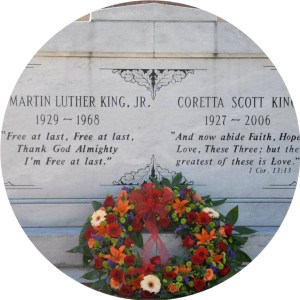
With several other members of my PS class, I scavenged the streets, tossing everything from empty cans to fallen concert flyers into my trash bag. While searching for trash, our group also took a break to see the MLK monument and to tour the house where Dr. King had grown up. The time on site flew by, and it wasn’t long at all before we surveyed our work, reloaded our tools, and headed back to campus.
During the week that followed, I made plans to meet Reverend Bobby on Sunday so that I could give him one of Georgia Tech’s “MLK Day of Service” t-shirts and pick up the remaining supplies that we had left at the church. As usual, I was on a tight schedule. My mom had driven to Atlanta from our home in Cartersville and we planned to have lunch and spend the day together. I hoped I would be able to make the exchange with Reverend Bobby in less than ten minutes so that we could be on our way, but my mom accompanied me into National Divine just in case the transaction did not progress so quickly.
As we peeked into the front door of the church soulful gospel music met my ears. An eager usher swooped my mother and me toward the pews before we had a chance to protest. I glanced at my mom, trying to convey that I was sorry to keep her waiting, but she gave me an accommodating and patient smile. Moved by the heartfelt music and the insistence of the usher, we had a seat toward the middle of the room. No more than twenty people sat in the small church, and it was a treat to hear Reverend Bobby preach to us on such a personal level. Every word he shared was fraught with passion and with meaning! When Revered Bobby saw me amongst the congregation, he also shared the story of how my PS class had come to volunteer at National Divine for MLK Day. I could tell how much our small contribution meant to Reverend Bobby and the rest of the appreciative community members in the church.
During the service, I spotted Charles whom I had met during the MLK Day of Service. As the congregation sent up one final “Amen!” I made my way to the front of the room to greet him and Revered Bobby. After introducing my mom to Charles, Revered Bobby swept the two of us over to two women standing nearby – his mother and his sister.
His mother was dressed from head to toe in an elegant purple dress and his sister shared the same glowing smile as Revered Bobby. Again and again they each looked into my eyes and thanked me for my service to their church and community. Then, with Mrs. Graham’s hands covering mine, the importance of the service I had performed at the beginning of the week became much more clear than it had been while I was clearing trash from the surrounding streets.
On the previous Monday, picking up litter in the historic neighborhood had seemed relatively insignificant; while combing the streets I had watched people throw down more cigarettes and gum wrappers just ten feet away from where I was cleaning. I didn’t exactly leave the project with a sense of accomplishment, and although I was glad that I had volunteered my time, the service I performed seemed somewhat trivial. It was not until I stood inside National Divine Church nearly a week later that I realized picking up trash was not the true value of the service I had performed.
The importance of MLK Day of Service was that our PS class took the time to show compassion to others and to another community outside of Georgia Tech. Mrs. Graham revealed for the first time how much the residents of the area felt cared about and loved because of the small tasks we had performed. Picking up trash was a small gesture, but it was an outward manifestation of a much grander gesture: understanding and valuing all people and all communities.
Our service mattered not because the streets were a little bit cleaner, but because we dedicated our limited time in order to make it clear how much the residents of the district mattered to our PS class and our Georgia Tech community. Reverend Bobby exemplifies this sentiment every day. Just a block away from National Divine Church stands the famous, prosperous, and prestigious Ebenezer Baptist Church, where Martin Luther King himself used to preach and attend services. Although I’m sure a man as talented and heartfelt as Revered Bobby could easily pastor Ebenezer’s congregation, he chooses to shepherd his flock at National Divine. Every day Revered Bobby teaches a lesson in servant leadership; he acts not for himself and for his own glory, but for the good of others. He is proud of his church and community, and he gives his life in service to their people. As a result, he is loved and revered by all those who know him.
As the saying goes, sometimes great or impactful things come in small packages. In some cases, picking up trash on Auburn Avenue or compassionately leading the spiritual lives of those within National Divine can have a greater impact than if our PS class had raised money to publicly erect a new Martin Luther King commemorative monument or if Revered Bobby began pastoring at Ebenezer Baptist Church.
The support and gratitude I was shown by the Graham family was encouraging, and that support did not end when I left National Divine Church. Reverend Bobby occasionally sends me an encouraging text message or prayer, and he always invites me to join him for another Sunday service – two things that mean a great deal to me. He has become my advocate, my friend, and one of my role models.
It is sad to think of what we miss when we are preoccupied within our own small worlds. I felt that even as a single student at Georgia Tech I was helping the greater Atlanta community positively change and progress. Sarah’s original message and the message of the retreat had come full circle. Active community service and striving for social justice impact our lives and the lives of others. Community service and seeking social justice are valuable in helping us understand our differences as well. By serving others we create a unity of humility, kindness, and love that knows no barriers or bounds.
 A Jacket's Journey