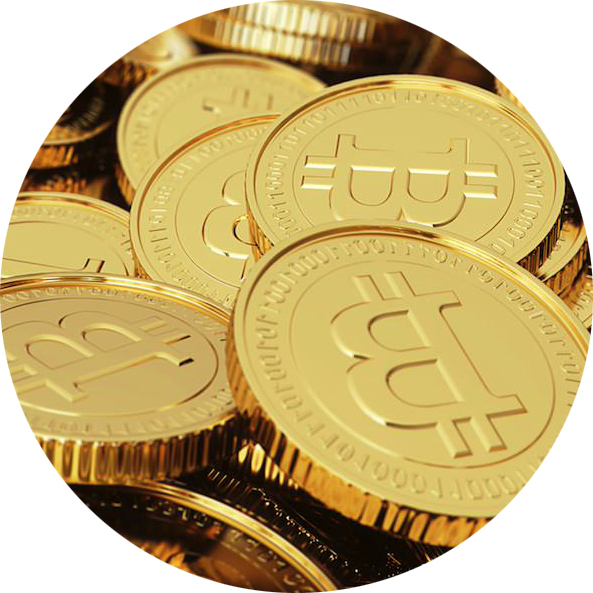
Many would consider stashing away a heap of solid gold bars in the deep recesses of a Gringott’s bank vault, veiled by some protective enchantments, and guarded by a fire-breathing dragon an optimal investment strategy. I would argue that such a scheme is far-fetched, and completely erroneous. But, not for the reason that one might think. To me, the existence of an alternate wizarding world is more reasonable than the belief that we should, and do, continue relying solely upon such antiquated investment strategies as hard assets and currencies.
In 2009, an individual, or group of individuals, under the pseudonym Satoshi Nakamoto released the world’s first digital currency, or payment platform, called the Bitcoin. Because this currency has been in circulation for less than a decade, it can be difficult to wrap one’s mind around its intangible nature. To gain a better understanding of Bitcoins, here are some basic facts:
- Bitcoins exist only electronically
- They result from an open source network
- Bitcoin transactions can take place anonymously, to an extent
- Bitcoins are a non-centralized form of currency
- They are released through a process called “mining” by individuals called “miners,” and anyone can act as a miner
- To mine for Bitcoins, one must successful verify complex mathematical transactions, which are based upon cryptographic hash
- If these transactions are successfully completed Bitcoins are “won”
- Bitcoins are released, by wining mining transactions, slowly over time; the system is currently designed to yield twenty five Bitcoins approximately every ten minutes
- Mining is designed to become more complex and difficult over time
- They can also be gained by purchasing them through a Bitcoin Exchange, or through a personal network
- Bitcoins can also be gained in receipt for goods or services, and can be used to make purchases of other tangible goods and services as well
- They are finite in number; 21 million Bitcoins will be released by the year 2140, at this rate, and release of Bitcoins is planned to cease at that time
If I walked into a Starbucks and attempted to pay for my latte with Monopoly money, the currency would quickly be denied, and I would be left severely under caffeinated. Why would my payment be denied? It is not necessarily because Monopoly money possesses less actual value that the more commonly accepted form of legal tender known as the US Dollar; both forms of compensation are similar in form and in cost of production. The reason that I would be deprived my frothy fix is because the societally perceived value of a green piece of paper with George Washington’s face is greater than a yellow piece of paper brandishing the image of Mr. Monopoly. As with our stifled knowledge of virtual privacy, or our skewed understanding of popularity from social media – our perception of reality IS our reality. One of the reasons that the advent and gradual acceptance of the Bitcoin is so fascinating is because it is essentially the legitimizing of Monopoly money. This new form of currency ushers in the possibility for an entirely new self-stabilizing, economic structure based on nothing more than a virtual perception of value. It is a monetary method whose initial value exists solely in the minds of its adopters and users.
And who are these users? There is an ever-expanding base of individuals who embrace the advent of this crypto-currency. And, as more people do so, the more valuable the Bitcoin becomes. When is the last time you heard someone proclaim, “Friend me on Myspace!” Never. Why? Because of the thousands of friends with whom we connect on Facebook, relatively few possess and upkeep Myspace accounts as well. The positive network externality of using Facebook is so high that it would be pointless to select any other platform when determining one’s social media preference. So it is with the use of Bitcoins. As the currency begins to proliferate, and it trends toward global acceptance, the value of the Bitcoin is naturally increasing. Now, you can effectively use the currency to purchase your favorite vegan, gluten free, non-GMO, Fair Trade certified kale chips at Whole Foods, make a donation to the United States Libertarian Party, or even to burn up some of your disposable income on the 2014 Lamborghini Aventador.
The intrinsic value of the Bitcoin is increasing for reasons beyond network externality, as well. The currency is decentralized, meaning that it has no core authority, repository, or bank. The strictly “click” instead of “brick” nature of the digital currency, and the peer to peer design of the economic system, significantly depresses overhead costs and lowers the transaction fees that are forwarded on to customers in traditional banking arrangements. And, the benefits of the Bitcoin are even greater still. Because the Bitcoin is only transacted in cyber space, it is a practically inflation resistant currency, meaning that it is mostly immune to the loss in value to which hard currencies are subjected over time. This inflation resistant property not only effectively raises the value of the currency, but is also encourages saving, decreases excessive consumption, and wards off unnecessary acquisition of debt. It is based on reliable mathematics, and not on the fickle, sometimes selfish motives of bankers and politicians. Again, the Bitcoin is progressive not just as a currency, but as an entire logical and more naturally stable economic system that can be applied across all borders. It is anticipated that the Bitcoin is to finance as the advent of the Internet was to publishing. The transnational nature of the Bitcoin allows for effortless, international adoption and use of the currency. From a capitalistic perspective, when markets are more accessible and globalized, businesses flourish. The Bitcoin has not just expanded, but created new opportunities to capture revenue.
With minuscule fee costs, freedom from negative inflationary pressures, and so many other potential financial gains, why hasn’t everyone jumped on the Bitcoin bandwagon? It certainly cannot be denied that such a revolutionary addition to the prevailing financial world also comes tied with hefty concerns. Some of these concerns are operational in nature, but others stem from complex social matters. The two major potential issues, as I see them, are anonymity and regulation. In terms of anonymity, only a limited amount of customer data made on Bitcoin exchanges can be traced. For this reason, many are concerned about the overall legitimacy, and stability, of the currency. For Bitcoins to be adopted at scale, they need to be trusted and supported by a wide user base. Concerns stemming from purchasing anonymity have been amplified by lack of regulation, which has resulted in an uncontrolled market. Sites where Bitcoins are exchanged, such as the Silk Road and the Dark Web, are hotbeds for illegal activity, like sex trafficking and illicit substance exchange. The goods and services sold on Bitcoin exchanges must be controlled to mitigate the effects of unlawful transactions.
As with any great innovation, there are inherent risks involved. Although I do advocate for some regulation of the Bicoin and of Bitcoin exchanges, I caution even more stringently against the over regulation of the industry. The United States must remain globally progressive. Just like high US business tax rates lead to corporate inversion, academic research suggests that over regulating the Bitcoin, at this stage, is almost certain to push innovation, and the associated returns, abroad. Additionally, attempting to halt the currency’s use or over regulating the currency will practically ensure its solely criminal usage.
At this time, roughly a quarter of the population is aware that Bicoins exist, and estimates reveal that just half a million people own Bitcoins. As I see it, this is an opportunity that is currently extremely under explored, and under exploited. In November 2013, one Bitcoin was briefly worth more than one ounce of gold. To me, that reveals that the potential for growth with this new virtual economic structure is colossal, and to advance, we must embrace it.
 A Jacket's Journey