Luke 12:48

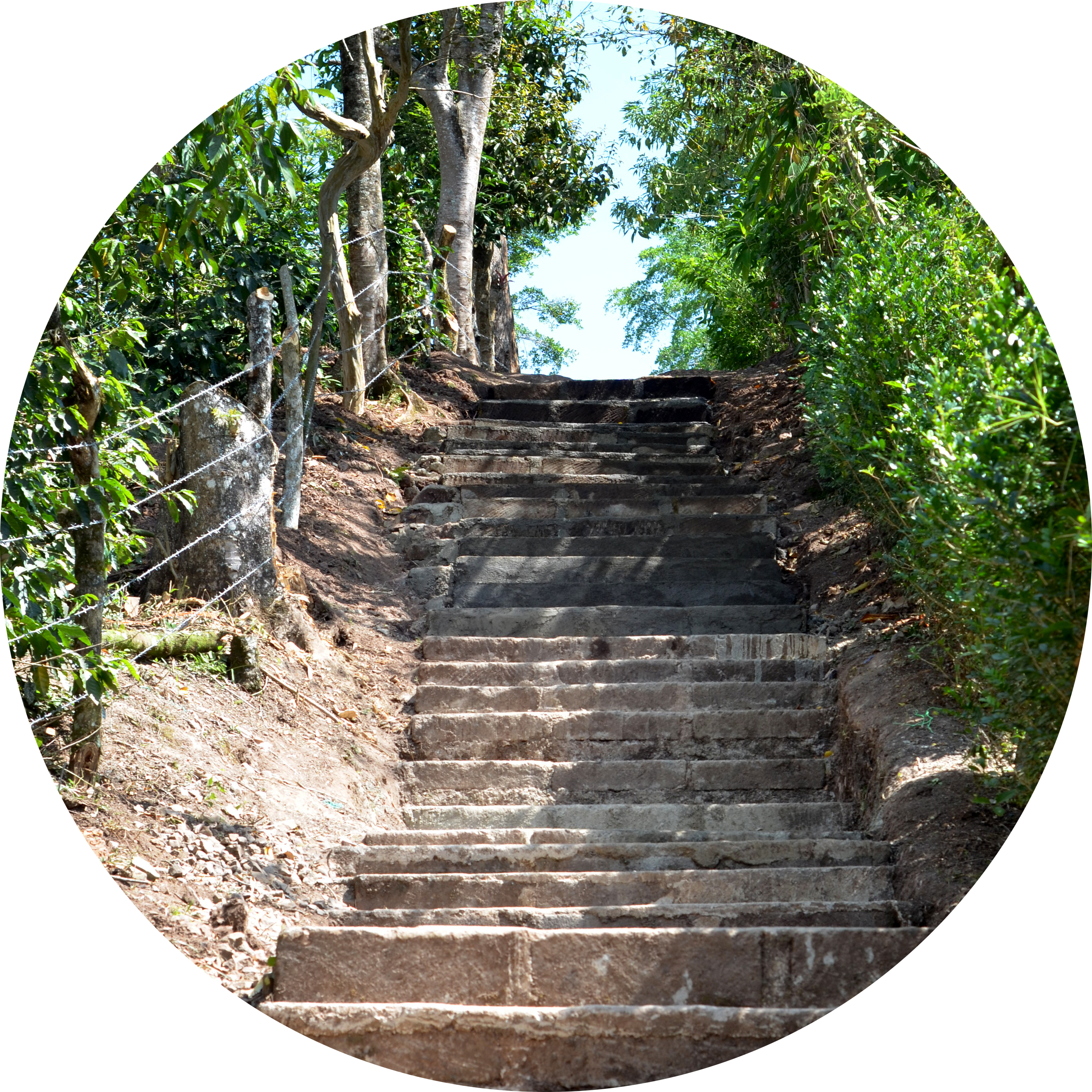
stairs

The corners of my mouth crept into a bittersweet grin as I saw the familiar face of a boy, clad in a red t-shirt and dusty blue jeans, ambling my way. It was my final day in La Corona, a small village in the Matagalpa region of Nicaragua, and I was not yet ready to say goodbye to Fernando. Although we did not speak the same language, we managed to develop a genuine friendship over the course of just seven days. He watched and helped as I led a team of twelve Georgia Tech students in hewing a large stone staircase into the side of a steep hill, which led to the community’s cemetery. Before our project’s completion, water would rush down the hill during the rainy season, and funeral processions were unable to advance up the cliff.

Unable to communicate otherwise, I greeted Fernando with my eyes, and gestured upward from the bottom of the staircase toward our finished product. He studied the stones we had carefully laid. I noticed dried concrete caked to the hem of his pants from the day before, and the tag and seams of his shirt that faced outward. Without forethought, I opened my mouth to tell Fernando that his shirt was inside out. However, before words could come, I inhaled sharply, and stood with my lips parted in a moment of realization and self-reproach: this was no accident. Sensing my surprise, Fernando turned his gaze to meet my stare. Fernando’s sheepish eyes said more than a thousand words could have ever expressed, and my suspicion was confirmed in a single, poignant juxtaposition of my own relative fortune with the local people’s humble lifestyle. I embraced Fernando once more before he walked away, leaving behind a stark reminder of my overwhelming privilege, and a renewed sense of purpose.

When departing from Nicaragua I recognized more clearly than ever before how fortunate I am. I have the luxury of wearing several sets of clothes each day, while Fernando has only one pair of pants and one shirt to wear for an entire week. Throughout my life, I have been entrusted with much – both tangibly and intangibly. I believe that to whom much has been given, much should be expected. I do not seek personal success when embracing the many opportunities I have been presented. Instead, I pursue success as a platform to positively impact the lives of others. I am grateful for my many experiences, and I feel that those experiences make me both capable, and obligated, to positively impact our world.

Four Candles

candle

“Ah! Välkommen!” Hanna squealed as she swept me into the kitchen of her quaint Swedish home. Maja smiled at me as she carefully stirred a steaming pot of noodles, and Ebba waved from her perch atop the counter. It was my last evening in Helsingborg, Sweden, where I had just completed a summer internship. While living in the city, Hanna, Maja, and Ebba had become my closest friends, and we planned to spend my last evening in the country enjoying dinner together on Hanna’s patio.

Soon, our backyard paradise became cloaked in a soft, sunset haze that made every sip of wine sweeter, every laugh more harmonious, and every flower more beautiful. We sat for hours, comparing our respective educational systems, and contrasting our countries’ governmental policies. We marveled at all the ways in which our lives were somehow so different, yet so much the same. I told them tales of nights spent with my brother, running barefoot through the grass, sparklers in hand on the Fourth of July. And they, in turn, recounted days spent dancing in blissful celebrations of the summer solstice. My three companions stared wide-eyed when they discovered that I had never tasted rhubarb pie – a delicacy as essential to the Swedish Midsommer as gingerbread cookies to Christmas. Hanna skipped from her chair to a nearby fence, where she snapped a stalk from a plant that was unfamiliar to me. As Maja carefully pared the rhubarb stalk with her knife, Hanna returned to the table with a dainty china bowl brimming with white crystals. The sugar paired perfectly with the rhubarb, but it wasn’t nearly enough to sweeten the bitter end of that marvelous night, or the end of my surreal summer in Sweden. We reveled in the last minutes of each other’s company as the sun finally sank behind the trees. Ebba clasped the candle flickering in the middle of the rough, wooden table, and used it to light the three that surrounded it. Enveloped in their warm glow, I embraced each of my dear friends one last time.

As I journeyed home that night, I reflected on the beauty of the evening, especially those last, cherished, candlelit moments. I pondered how Ebba lighting the other candles did not diminish the strength of the original candle’s flame. In fact, together, the four lights became collectively stronger. And, I realized, so had we. In all of my travels, my light has grown brighter, not by simply taking knowledge and experiences, but from sharing in them. In doing such, I have learned that it is both our similarities and our differences that make us strong when we unite our flames. Our world is teeming with so many brightly burning candles – there are many wonders waiting to be explored, admired, and shared. I have found joy in seeking out these wonders, and in embracing the journey of life. I feel blessed each day that I am able to participate in our great, collective existence. Although I am but one small part of this existence, I am one part that strives to gratefully contribute. For me, writing and photography are outlets through which I attempt to quantify, express, and share the overwhelming delight and inspiration that I continually feel. This may add only one, short verse to the great novel of our humanity, but I believe that together our stories compose a magnificent, interconnected masterpiece of which I yearn to be a part.

Put the Lime in the Coke, You Nut

southwest

In many, many ways, I take after my mother. One such way is that we are both Cyclical Eaters. If asked, my mother will humorously describe what she refers to as the “Summer of the B.E.L.T. (Bacon, Egg, Lettuce, and Tomato sandwich)” or the “Only Oatmeal Phase.” Both were times when she ate almost exclusively the foods for which the time periods were entitled.

I have experienced similar seasons of my own: the “Peanut Butter and Banana Bonanza,” and currently, the “Southwest Chicken Salad Stage,” to name a couple. Cyclical Eating Syndrome (CES) has many characteristics. One such symptom is the inability of the afflicted to fathom a time when he or she will not want to eat the target food. Furthermore, even if the CES victim can come to grips with the reality that he or she will one day no longer have such desires, the individual certainly cannot predict when freedom from cuisine captivity may actually come.

Many say that the first step to recovery is to admit that you have a problem. And, in terms of the McDonald’s Southwest Chicken Salad Stage… I know I have a problem. This being said, perhaps you will pity me as I relay how I find myself munching the savory combination of romaine lettuce, succulent corn kernels, and crispy tortilla chips, on average, five or six times a week.

Each time I eye the delectable salad, I cannot help but puzzle over one small detail – the sneaky little lime wedge. You see, considering that I can hardly shovel the flavorsome fare into my mouth quickly enough, the single piece of lime that is included atop the salad rather inconveniences me. Not to mention, as the only bit of the salad that is not completely edible, it poses a significant choking hazard when I am engaged in such rapid chow consumption.

For you, McDonald’s, I have a simple recommendation: nix the lime wedge. Not only might you save yourself thousands in potential litigation fees (not learning from experience on this one, I see – reference Liebeck v. McDonald’s, 1994), but I would also be willing to bet that you might save millions in input costs.

After taking a stroll down the street to my friendly neighborhood grocery, I can report that a single lime now costs roughly $0.30. I can also confidently assert that a single fruit will yield eight lime wedges. Further research indicates that McDonald’s sold approximately twenty-five million of their Southwest Chicken Salads in the year 2013. With this data, we can perform some underwhelming calculations that lead us to a dichotomously overwhelming conclusion. If McDonald’s were to stop adding that pesky slice of lime to their Southwest Chicken Salad, not only would they save their number-one salad supporter from irritation, but they would also accumulate approximately $1,000,000 per year in cost savings. 

This brings us to another interesting and little known fact. Droughts and cold weather have crippled lime production this year, and as a result, a shortage of the fruit has been created. In accordance with the laws of supply and demand, lime prices soared to $1.50 a piece in May of 2014. So, in this particular year, even greater savings could have been realized.

Why, you might ask, am I belaboring the importance of a minuscule slice of lime? I am doing so for several important business reasons: 

  • Challenge existing standards and norms
  • Remember and pay attention to the little things
  • Understand the importance of cost-benefit analysis

In business, and in all facets of life, these are important rules of thumb. Never get so bogged down in routine and in prevailing practices that you forget to ask one of the most important and fundamental questions: Why? Conversely, never get so focused on grandiose ideas and that you overlook critical details. And, remember that for every opportunity, there is a related cost, and a related benefit. That cost may be making a lower grade on your biology midterm to spend time with family and friends, or the benefit may be forgoing such an opportunity for a better GPA that might land you a stellar job. In this instance, the cost of losing customers by removing a single, unnoticeable slice of lime is negligible, and the benefit of a $1,000,000 cost savings is incredible. So, in my opinion, the lime wedge is better kept in a Coke, or on a pie, or wherever else a lime may well belong. For the sake of good business, it does not belong on my McDonald’s Southwest Chicken Salad.

Bitcoins: Worth their Weight in… Bitcoins?

Untitled-10

Many would consider stashing away a heap of solid gold bars in the deep recesses of a Gringott’s bank vault, veiled by some protective enchantments, and guarded by a fire-breathing dragon an optimal investment strategy. I would argue that such a scheme is far-fetched, and completely erroneous. But, not for the reason that one might think. To me, the existence of an alternate wizarding world is more reasonable than the belief that we should, and do, continue relying solely upon such antiquated investment strategies as hard assets and currencies.

In 2009, an individual, or group of individuals, under the pseudonym Satoshi Nakamoto released the world’s first digital currency, or payment platform, called the Bitcoin. Because this currency has been in circulation for less than a decade, it can be difficult to wrap one’s mind around its intangible nature. To gain a better understanding of Bitcoins, here are some basic facts:

  • Bitcoins exist only electronically
  • They result from an open source network
  • Bitcoin transactions can take place anonymously, to an extent
  • Bitcoins are a non-centralized form of currency
  • They are released through a process called “mining” by individuals called “miners,” and anyone can act as a miner
  • To mine for Bitcoins, one must successful verify complex mathematical transactions, which are based upon cryptographic hash
  • If these transactions are successfully completed Bitcoins are “won”
  • Bitcoins are released, by wining mining transactions, slowly over time; the system is currently designed to yield twenty five Bitcoins approximately every ten minutes
  • Mining is designed to become more complex and difficult over time
  • They can also be gained by purchasing them through a Bitcoin Exchange, or through a personal network
  • Bitcoins can also be gained in receipt for goods or services, and can be used to make purchases of other tangible goods and services as well
  • They are finite in number; 21 million Bitcoins will be released by the year 2140, at this rate, and release of Bitcoins is planned to cease at that time

 If I walked into a Starbucks and attempted to pay for my latte with Monopoly money, the currency would quickly be denied, and I would be left severely under caffeinated. Why would my payment be denied? It is not necessarily because Monopoly money possesses less actual value that the more commonly accepted form of legal tender known as the US Dollar; both forms of compensation are similar in form and in cost of production. The reason that I would be deprived my frothy fix is because the societally perceived value of a green piece of paper with George Washington’s face is greater than a yellow piece of paper brandishing the image of Mr. Monopoly. As with our stifled knowledge of virtual privacy, or our skewed understanding of popularity from social media – our perception of reality IS our reality. One of the reasons that the advent and gradual acceptance of the Bitcoin is so fascinating is because it is essentially the legitimizing of Monopoly money. This new form of currency ushers in the possibility for an entirely new self-stabilizing, economic structure based on nothing more than a virtual perception of value. It is a monetary method whose initial value exists solely in the minds of its adopters and users.

And who are these users? There is an ever-expanding base of individuals who embrace the advent of this crypto-currency. And, as more people do so, the more valuable the Bitcoin becomes. When is the last time you heard someone proclaim, “Friend me on Myspace!” Never. Why? Because of the thousands of friends with whom we connect on Facebook, relatively few possess and upkeep Myspace accounts as well. The positive network externality of using Facebook is so high that it would be pointless to select any other platform when determining one’s social media preference. So it is with the use of Bitcoins. As the currency begins to proliferate, and it trends toward global acceptance, the value of the Bitcoin is naturally increasing. Now, you can effectively use the currency to purchase your favorite vegan, gluten free, non-GMO, Fair Trade certified kale chips at Whole Foods, make a donation to the United States Libertarian Party, or even to burn up some of your disposable income on the 2014 Lamborghini Aventador.

The intrinsic value of the Bitcoin is increasing for reasons beyond network externality, as well. The currency is decentralized, meaning that it has no core authority, repository, or bank. The strictly “click” instead of “brick” nature of the digital currency, and the peer to peer design of the economic system, significantly depresses overhead costs and lowers the transaction fees that are forwarded on to customers in traditional banking arrangements. And, the benefits of the Bitcoin are even greater still. Because the Bitcoin is only transacted in cyber space, it is a practically inflation resistant currency, meaning that it is mostly immune to the loss in value to which hard currencies are subjected over time. This inflation resistant property not only effectively raises the value of the currency, but is also encourages saving, decreases excessive consumption, and wards off unnecessary acquisition of debt. It is based on reliable mathematics, and not on the fickle, sometimes selfish motives of bankers and politicians. Again, the Bitcoin is progressive not just as a currency, but as an entire logical and more naturally stable economic system that can be applied across all borders. It is anticipated that the Bitcoin is to finance as the advent of the Internet was to publishing. The transnational nature of the Bitcoin allows for effortless, international adoption and use of the currency. From a capitalistic perspective, when markets are more accessible and globalized, businesses flourish. The Bitcoin has not just expanded, but created new opportunities to capture revenue.

With minuscule fee costs, freedom from negative inflationary pressures, and so many other potential financial gains, why hasn’t everyone jumped on the Bitcoin bandwagon? It certainly cannot be denied that such a revolutionary addition to the prevailing financial world also comes tied with hefty concerns. Some of these concerns are operational in nature, but others stem from complex social matters. The two major potential issues, as I see them, are anonymity and regulation. In terms of anonymity, only a limited amount of customer data made on Bitcoin exchanges can be traced. For this reason, many are concerned about the overall legitimacy, and stability, of the currency. For Bitcoins to be adopted at scale, they need to be trusted and supported by a wide user base. Concerns stemming from purchasing anonymity have been amplified by lack of regulation, which has resulted in an uncontrolled market. Sites where Bitcoins are exchanged, such as the Silk Road and the Dark Web, are hotbeds for illegal activity, like sex trafficking and illicit substance exchange. The goods and services sold on Bitcoin exchanges must be controlled to mitigate the effects of unlawful transactions.

As with any great innovation, there are inherent risks involved. Although I do advocate for some regulation of the Bicoin and of Bitcoin exchanges, I caution even more stringently against the over regulation of the industry. The United States must remain globally progressive. Just like high US business tax rates lead to corporate inversion, academic research suggests that over regulating the Bitcoin, at this stage, is almost certain to push innovation, and the associated returns, abroad. Additionally, attempting to halt the currency’s use or over regulating the currency will practically ensure its solely criminal usage.

At this time, roughly a quarter of the population is aware that Bicoins exist, and estimates reveal that just half a million people own Bitcoins. As I see it, this is an opportunity that is currently extremely under explored, and under exploited. In November 2013, one Bitcoin was briefly worth more than one ounce of gold. To me, that reveals that the potential for growth with this new virtual economic structure is colossal, and to advance, we must embrace it.

Sustainability: A Defining Issue of Our Generation

Untitled-9

Energy costs are high, finite supplies of raw materials exist, clean water is difficult to preserve, and waste production is rising. To sustain our current lifestyles, our planet must produce as much in the next forty years as it has in the previous eight thousand years combined, even with intensifying environmental constraints. By 2050, the planet’s population will increase by twenty-three percent, and an increase in average household income will result in doubled worldwide consumption. Additionally, consumers dictate that businesses provide progressively more sustainable goods and services. For businesses to meet quantitatively greater and qualitatively more stringent consumer demands, entrepreneurial and innovative strategies are not just laudable, but necessary in the pursuit to drive globally sustainable products, services, technologies, and solutions. A commitment to sustainability in all pursuits, and especially in business, will likely be the defining issue of my generation. Global businesses are not only ethically responsible for supporting sustainability, but they are also the preeminent institutions powerful enough to effectively advocate for, and push forward the agenda of establishing a greener economy. Business and society can mutually benefit by overcoming sustainability challenges together.

Journal

Buttered Popcorn

As kids, Jake was always the brave explorer. He would mash any button, thrash through any woodland trail, and test any cuisine. There was an entire summer during which Jake dragged Mom and me to the most obscure restaurants in Cartersville, Georgia in an attempt to satisfy his adventurous taste buds.

We slurped down greasy French fries and hot dogs at the Four Way Lunch, we tested spicy Louisiana crawfish at Gumbo to Go, and we nibbled on minced meat covered cardboard at Tacos and Subs. Even when my stomach turned at the sight of some of the provisions we encountered, Jake wiped his hands, clutched his fork, and usually gulped down the remainder of my meal as well. Jake had such a stomach of steel that to this day I distinctly remember the first edible encounter he just couldn’t handle.

It was just after Christmas and Jake and I crunched happily through the snow-covered sidewalk, trailing Mom and Dad. As was our ski vacation tradition, our family had braved the cold and made the trip into downtown Steamboat Springs, Colorado. Here we always marveled at the glowing holiday lights that dotted the snow-covered evergreens and purchased chocolate “avalanche” from Mom’s favorite Colorado candy shop.

Jake and me both let our jaws fall to the floor as the bells jingled on the door entering the Rocky Mountain Chocolate Shop. From floor to ceiling every square inch of wall leaked with sugar dusted gumdrops, pretzels drenched in smooth chocolate and glistening bricks of fudge.

While we frolicked through the store, admiring the delights, Dad told Jake and I we could both pick a treat to take with us on the trip back to the condo.  Before I could plunge the little red scoop into the sea of chocolate covered raisins, Jake shrieked, “WAIT!” Puzzled by what could possibly cause him to halt my sugary sojourn, I craned my neck to see him staring at a display of small boxes in the corner of the store. Intrigued, I reluctantly turned my back on my favorite candy to investigate his finding.

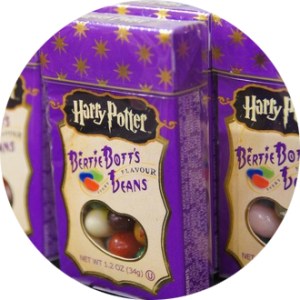
I was nine and Jake was still eight. In our minds, receiving the remainder of our education at Hogwart’s School of Witchcraft and Wizardry was still a very real possibility. That’s why once we laid eyes on Bertie Bott’s Every Flavored Beans, we refused to leave the candy shop without them. We raced to the cashier and carefully placed our treasures in her possession.

“You’re sure that’s what you guys want?” Mom and Dad both asked.

“Absolutely,” Jake and I responded in unison.

We teetered back outside, clutching our packages tightly against our chests. As soon as we boarded the bus, Jake and I tramped to the very last row and wedged our way between our parents, facing the open interior.  Wide-eyed, we pried the tops of our cardboard boxes open. Fingering the smooth, oblong bean, I scanned the side of the box. By the speckled pink coating I gleaned that I held “strawberry cheesecake” in my palm.

“Dirt.” Jake said aloud, also examining the side of his carton.

“Maybe we should start with some good ones and then eat a few of the weird ones when we’re warmed up?” I offered.

“Nah, are you kidding me? I eat dirt all the time!” Jake giggled as he popped the jellybean into his mouth. I stared, waiting for his gag reflex to kick in. “Deeeelicious!” he resounded, without so much as a cough.

As the ride continued, I stuck mainly to the normal, fruity flavored beans in the box, occasionally venturing out to try the “soap” or the “black pepper.” Jake however, in his usual exploratory style, easily downed the “soap” and much to my disgust, even the “vomit” and “earthworm.”

With two stops left to go, I had consumed nearly every viable jellybean in my box, but Jake was still going strong.

“What’s that one?” I asked, as he studied the seemingly harmless yellow piece of candy.

“It’s just buttered popcorn,” he replied with dismay.

“Oh! I still have one of those too. Let’s eat them together. On the count of three!” I said, fairly confident in my ability handle this flavor. “One, two, three!” And with that, we threw the sugary wads into our mouths and began to munch.

Relief washed over me. This one actually tasted pretty good! Much better than the remainder of my box, I was sure. I glanced over at Jake, seeking praise for my new flavorful conquest. But something was wrong, very wrong.

I was certain Jake must have eaten too much “grass,” because his face was starting to turn the color of our front lawn in the summer. His mouth contorted and his body squirmed. What was happening??? Had some hex or curse from the magical beans befallen him? I had to help! “JAKE!” I screamed, thrusting out my arm to support him.

If only Hermione Granger had been there I’m sure she could have whipped up a potion to stop the events that ensued, but as it stood, my sorcery experience had been restricted to waving about sticks at home in our back yard. Therefore, I was unable to do anything but watch in terror as Jake’s entire box of Bertie Bott’s Every Flavored Beans made a second, half-digested appearance.

“Woho hooooo! Gnarly dude!” the two grungy snowboarders beside us yelled, half in disgust, half in grotesque amusement as they jumped away from the sickening heap Jake had projected onto the floor.

“What flavor was that???” Mom exclaimed, half laughing and half crying at the scene we had created. Jake dismally replied, knowing that his stomach had finally met its match, “Buttered popcorn.”

Hamburg, Germany

Unable to move toward the exit of the crowded train car, I looked out the small, dirty window to my right and on to the station platform. My heart leapt as I saw a familiar face for the first time in over a month! There stood my high school friend Weston Read, resting heavily on his crutches and searching me out in the crowd.

As soon as I was clear from the pack of travellers, I practically jumped from the train. I gave him a big hug and a sad smile, “How’s your knee holding up?” Weston, always cheerful and optimistic, grinned and averted the subject almost completely. He said it was fine and he was excited to see me and to show me around the city.

After graduating from the same high school as me in Cartersville, Georgia, Weston spent two years playing soccer at Anderson University in South Carolina. When he tore his ACL for the first time, he had an artificial ligament surgically implanted and underwent intensive therapy. He worked hard and before long, he was ready to get back on the pitch, but he was also ready for a change of pace. He bravely moved to Flensburg, Germany to pursue his dream of playing on a European national team. Just when everything had fallen into place and Weston was ready to make his debut, his ACL relapsed, and he was forced to stop playing once again. Although Weston planned to return to the States to regroup, he was still living in Flensburg for a few more weeks and he agreed to meet me in nearby Hamburg before his departure.

As we exited the train station I took in the city for the first time. Clean, lively, and beautiful. Bridges and canals wove through the city like a child’s pencil dragging through a complicated maze.  Weston told me that there were over 2,300 bridges in Hamburg – more than both Amsterdam and Venice combined.

We breezed through the center of town along two wide boulevards that paved a path toward the Rathaus, or city hall. In front of the imposing building, Weston stopped a local and, much to my surprise, asked in excellent German if he would take a picture of the two of us. The man was the friendliest of any I had met in my summer travels, and he snapped photo after photo while asking us how we were enjoying the city and pointing out some of the must-see sights.

Next, we steered ourselves in the direction of Hamburger Hafen, or the Port of Hamburg, which is known as “Germany’s Gateway to the World.” Although it is not a costal city, Hamburg is connected to the North Sea by a thirty-mile stretch of the Elbe River. Consequently, Hamburg is one of the most critical trading hubs in Western Europe”. On the way toward the harbor, we stopped at a local grocery store where Weston plucked two clear glass bottles filled with a sizzling cola from the shelves. Walking outside he popped the bottle tops and thrust one into my hand, “Cheers! It’s Fritz-kola. It originated near Hamburg and it’s really popular in this part of Germany. This is my favorite flavor. It’s mostly like Coke, but with a little bit of coffee. Try it, you’ll really like it!”

Impressed by how much Weston had learned in his six months away from America, I took a swig as we sat down in the warm sun on a bank just above water level. It was so nice to see an old friend, and we sat for hours talking and catching up. Long after the Fritz-kola was gone and the most pressing stories had been shared, we meandered to a nearby dock where we boarded the water taxi. We slashed through the harbor, taking in the sights from the water. When we docked again, we hopped off and headed to a local hamburger joint for a bite to eat.

The origin of the hamburger is greatly disputed, but one likely origin is that the now typical American fare was created by a German cook named Otto Kuasw. Back in 1891 Otto concocted a popular sailors’ sandwich composed of a beef patty fillet fried in butter that was also served with a fried egg between two toasted buns. The shop where he sold the “Deutsches Beefsteak” was right in the city of Hamburg.  Around this time, the Hamburg Hafen became a major departure point for the trans-Atlantic ship line that carried passengers to New York City. It is said that many of the sailors who travelled to the U.S. by this route requested a similar “Hamburg style” sandwich at American restaurants, popularizing the German invention in the United States.

After pondering the controversial origin with another kind local, we left the restaurant and explored more of the animated city, even managing to sneak into the St. Pauli Football Club stadium. As the sun sank low in the sky, I gave Weston one last hug goodbye as we both promised that we’d see each other back in America soon!

Helsinki, Finland

Although it was close to four in the morning as I hustled toward Helsingborg Centralstation, pink, wispy clouds were already painting a watercolor picture across the sunlight summer sky. I folded my arms tightly, snuggling even tighter into my cozy sweater cocoon. After I finished the long haul from Helsingborg, Sweden to Helsinki, Finland the weather would be even cooler and the sun would rise even earlier because of a four-degree gain in northern latitude.

Once inside the Helsingborg transit hub, several other luggage-bearing travellers and I climbed aboard the Scandlines ferry that would carry us across the Oresund Sound from Hesingborg, Sweden, to Helsingor, Denmark in just twenty minutes. Ordinarily I would have travelled from Helsingborg Centralstation to Copenhagen via train, but I was taking an indirect route because it was so early that the direct trains to the airport had not yet started running. After climbing the sticky stairs to passenger deck, I situated myself at bow of the boat next to a large window. Never before had I travelled on a ferry, and I watched curiously as men in neon yellow vests ushered car after car into perfect alignment just below my perch.

The entire bulky vessel began to shake like a 1960’s weight loss machine. Much to my surprise, the anchor was drawn, the tension slackened, and in a matter of moments the mammoth boat began to glide effortlessly through the water like a swan on a glass lake.

It was not long before I had reached Kastrup Airport in Copenhagen, where my flight to Helsinki would soon depart. As I heaved my backpack up to my shoulder and headed toward security, I reached inside my purse to prepare my passport and boarding documents. My fingers groped inside the fabric interior, but they failed to grasp the object they sought. I stopped walking and gasped, eyes wide. Panic struck when I realized that my passport was resting inside the closet inside my apartment, an hour and a half away from where I stood.

I hadn’t been asked to provide documentation during any of my inter-country excursions since arriving in Europe, but I always carried my passport when travelling just in case any problems did arise. However, the knot in my stomach warned me that soon my good friend Irony was likely to play one of her satirical pranks.

Stepping toward the security checkpoint, I tossed my jacket, my iPad, and my belt into a bin, doing my very best to look, Scandanavian, inconspicuous, and well travelled. The man directly in front of me failed to feign such a convincing act. With his light-wash jeans, bright white sneakers and baseball cap, he loudly inquired, “Can I leave my shoes on?” After raising an eyebrow and giving him the once over, a nearby agent told him he could while shooting a telling glance to his partner on the other side of the metal detector.

It was now my turn to attempt the passage. I glanced toward the first security guard, shaking my head a little and giving him an “Oh, those Americans” smile. He returned the sentiment and lifted his hand, waving me through. I held my breath as I passed through the gateway. I was safe! I snagged my belongings and dodged the man who had been in front of me, who now watched as his bag was searched and his passport reviewed.  My only concern was that I wouldn’t have the same luck on my return flight from Finland…

Just two hours later, after making my way by foot, ferry, train and plane, I boarded bus 601 just outside the Helsinki Airport. As the vehicle hummed into the city, I contemplated the attractions I planned to visit during my two-day stay. I intended to check into my hotel, orienting myself to the area, and tour the main sights like Senate Square and the Helsinki University Botanical Gardens. Then, I would venture to the more unique attractions like the photography museum and the local markets the next morning before my return flight. I had also carved out several hours in the early evening to experience the most time-honored Finnish tradition: the sauna.

The reason that I enjoy travelling is because it provides the best opportunity to experience new people, new cultures, and entire new worlds first hand. It helps me learn and grow, almost through osmosis at times. When exploring somewhere new, I always find myself learning in unintended, unplanned ways. Since I appreciate personal growth as one of the main benefits of travelling, I also feel that if my mind is not open to accepting new experiences, this growth will not occur, and the main value travelling provides is lost.

That is why after reading about the etiquette and traditions of the Finnish sauna I was daunted, but not deterred. The idea of a sauna in and of itself did not intimidate me. As a Georgia girl, the thought of a warm wooden room, filled with the aroma of aged cedar walls was actually very appealing since the Scandinavian summer climate is comparable to the coolest of Atlanta’s fall days. As a true Georgia Tech student, I had done my pre-trip research, and it was the customs of Finnish sauna that evoked my concern.

Throughout Finland, there are more saunas than households. Many of them are private, within individual residences or hotels, but many of them are public as well. In ways, the Finnish sauna is similar to a day spa in the United States. The saunas are in bathhouses separated by gender, usually with females on the second floor and men on the first. Finns believe strongly in the health benefits saunas provide.

In a nutshell, it is customary to enter the sauna, receive a towel and a sitting mat, pay for a “scrub,” troop to the appropriate floor, strip to your birthday suit, and enter the sweltering wooden room to bake for hours at a time whilst intermittently smacking yourself with branches from a birch tree. Only after sweltering for the better part of an hour will “the scrubber” arrive to provide the spa’s most popular service. Even after learning of these foreign customs, I was determined that I would not leave Finland without attempting an adventure to the sauna.

Later that day, as I marched up the hill toward the red neon sign like a soldier heading to battle, I felt strangely invigorated! The thought of experiencing something so new and unique left me feeling brave and excited, not awkward and intimidated like I had expected. But, my confidence began to melt like butter on a hot skillet when I cleared a tree that had been obstructing my view. There I saw for the first time nearly fifteen men sitting outside the sauna. Vapours swirled through the air as the heat of their bodies, bare apart from the short towels swaddling their legs and waist, made contact with the crisp air.

I looked myself over. I was clad in my Miss Me blue jeans, Alpha Chi Omega sorority t-shirt, Patagonia jacket, and Nike tennis shoes with neon pink laces. With my backpack and perpetually curious demeanour, I’m sure I stood out like a fox in a hen house. Or in this case… the only American female in the Finnish sauna house.

Although my feet faltered for just a moment, it wasn’t long before I regained my composure and plastered a goofy smile to my face, deciding to fully embrace my alien appearance. I even stopped and took a picture of the sign that clung to the side of the crumbling brick building. After some rough communication with the woman at the front desk, I managed to secure a day pass to the second floor women’s sauna, a clean towel and mat, and a traditional “scrub,” all for about twenty euros.

Proudly, I clomped up the stairs and around a corner, throwing my backpack and every stitch of my clothing into a locker. I stood, stark naked in the neat little locker room, eyeing the four doors that lined the walls and wondering which I should enter. After a few minutes of observation, I opted for the door on my far right. I had seen several other women, as bare as me, traverse the threshold and I thought that it must be some type of antechamber to the sauna.

I tiptoed into the tile room lined with towel hooks, showers and wooden benches. Although I was weary of calling any attention to myself, I had decided it would be acceptable for me to don the tattered towel en route to the sauna. I knew that Finns actually found it offensive if a person refused to drop their drawers while in the bathhouse, and I didn’t want to be hurled back outside in front of the hoard of half-clothed men for committing such a faux pas.

In the corner of the room a rickety wooden door hung slightly askew on its rusty hinges – I was certain I had finally come to the right place. As I approached the sauna I was again consumed with elation and a sense of accomplishment that can only come from roaming unaccompanied and unclothed through a foreign land. As I burst into the sauna with a new-found sense of freedom, I cast my towel to the side with wild abandon, embracing true, Finnish tradition!

My satisfied smile and starry-eyed gaze vanished the moment I let the door slam behind me. As I scanned the figures scattered across the hot wooden benches, I realized that not a single woman, beside myself, had decided to adopt conventional sauna customs. I just stood for a moment with the crowd taking me in as they might assess an elephant in a circus ring. It was then that I realized that these girls, all ten of them, were speaking perfect American English.

Irony had decided to play her trick after all. After three weeks at my summer internship in Sweden, during which I had received absolutely NO interaction with anyone from my home country or from my same birth decade,  I had come half way across the world to a public sauna tucked away in the back alley of Helsinki, Finland only to find nearly a dozen other college aged American girls.

But, the die had been cast and there was no turning back now. I chuckled and, with a shrug, I flipped the towel over my shoulder and sat down amongst them. Despite the awkward environment, I really enjoyed the company of the clan. Each girl hailed from a different college back in the States, but they had all joined together for a furniture and interior design study abroad trip. Time passed, with many of the girls exiting the sauna every five minutes or so to retrieve buckets of cold water or to catch a breath of cool air. Just when I had become comfortable with the whole situation, “the scrubber” came.

The concept of a scrubber is one I had never before encountered. The large, pink-cheeked woman ambled my way, straining to tie an apron about her waist. In very limited English, she told me to come with her, and I obliged. Nervously, I hung up my towel and glanced toward her, where she motioned for me to lie down on a waist high bed, draped in a large piece of plastic.

“On my back or on my chest?” I asked, already unsure of myself.

“Whatever pleases you!” She replied.

The plastic tarp was light pink and printed with drawings of steaming cups of coffee dancing across its slick surface. Occasionally the words “coffee,” “caffe,” and “mocha” punctuated the artful beverage display. Somehow I found this décor to be the oddest part of the entire situation. I decided that resting on my stomach would be the most comfortable way to begin the scrub.

I felt like the catch-of-the-day as the big-boned Finnish woman hosed me down with warm water, grabbed a loofah, and proceeded to, well… scrub me. She combed every inch of me from the hairs on my head to between the toes on my feet. She did it this twice, then she flipped me over, and she scrubbed me again. Still feeling like a flounder fillet, I looked to her for assurance when I thought the scrubbing had concluded. She nodded and I slipped off the table, uncomfortably thanking her and snagging my towel before retreating to the sauna once more.

Although the situation was strange, I actually felt wonderful. And I think I would have enjoyed myself even more if I hadn’t been such an inexperienced Finnish sauna goer. During my scrub, all of the American girls had trickled out from the bathhouse and I remained in the warm room with two Finnish women, who were relaxing the “proper way.” When I was certain I would shrivel like a raisin if I stayed much longer, I showered off, dressed, and triumphantly headed to explore the rest of Helsinki, refreshed and relaxed.

Glad Svensk Midsommar Firande

A celebration of the summer solstice (held during the year 2013 on June 21st), Svensk Midsommer formerly served as an opportunity to offer praise in hope of a good harvest. Although traditions have remained the same, the intent of the celebration has shifted to recognize both the dependence of Swedish culture on the sun as well as the timeless mysteries of summer love.

In Sweden, Midsommer is undoubtedly the largest celebration of the year! I was very fortunate to be able to indulge in and experience the rich Swedish heritage surrounding the festival and to come away with a better understanding of the country’s culture and traditions.

1. Party Prep

Although some parks and castles hold public celebrations of the holiday, Midsommer is typically reserved for smaller gatherings of close families and friends in private gardens. The Swedes labor for weeks potting flowers, plucking weeds, and trimming lawns to prepare a picturesque stage for the biggest production of the year. The star of the show? The Maypole. The Maypole is essentially a large wooden pole that is dressed in flowers, garlands, birch leaves, and branches. Although it can take on many shapes, it is most commonly erected as a tall cross with a sloping triangular roof and a circular wreath draped on either side. The carrying, dressing, and hoisting of the Maypole, which are all completed on Midsommer’s Eve, signify the true beginning of the celebration.

2. Dress for Success

During the public celebrations, it is typical to see Swedish men, women and children adorned in traditional Swedish garb. Young girls proudly display the colors of the Swedish flag through their floor length royal blue cotton dresses and canary yellow aprons.  Men often don high knee socks, classic britches and buttoned vests in vibrant hues.

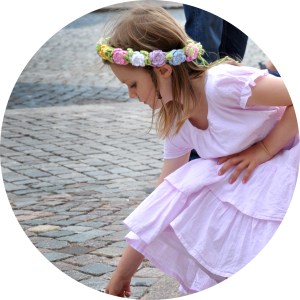
For ladies of all generations, a floral headdress is a necessity. These are worn both in the public celebrations and in the private garden parties. Making the floral headdresses by hand is the most traditional method, but in the present day, many Swedish women place orders at local floral shops in order to have elaborate blossoming crowns woven for the occasion.

3. Culinary Classics

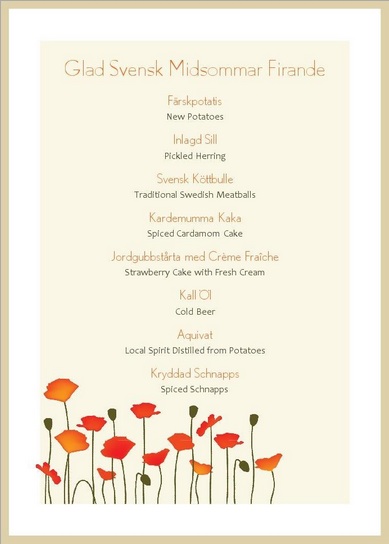
Because Midsommer is a time to celebrate both the fruits of the earth and the fellowship of loved ones, hosting a classic Swedish feast is critical at any garden party. Meals are always hosted outside in fair weather and children are given Swedish candies as a special treat for this time of year. Below is a traditional Swedish Midsummer menu that was served at my office the day before Midsummer holiday!

Midsommer Menu

4. Sing and Swing

Besides serving as a beautiful garden centrepiece, the Maypole’s serves as the center of the dance floor as well. Regardless of the number of guests at the party, everyone must join hands and frolic around the Maypole! Although the intricacies of the dances are more complicated, especially when the ring of dancers breaks apart to form pairs, generally skipping and running around the Maypole in a circle adequately mimics the traditional style. The direction of the circles movement changes in time with the music and the dancing is occasionally paused for theatrical acting interludes according to the song’s lyrics. Dancing around the Maypole not only celebrates the bounty of the lush Swedish wilderness, but it also fills the air with subtle messages of love and affection as the evening approaches. Apart from dancing, other activities like singing, hayrides, and lottery tombola are enjoyed during the festival.

5. Long for Love

As the long day draws toward a close and partygoers begin to wander home, the final Midsommer tradition is celebrated. As young girls pad through the meadows on their way home, they strive to collect seven different types of wildflowers whilst ascending over seven wooden fence posts along their journey. Not a word can be spoken during this solitary expedition, as the pristine condition of the wilderness and the magic of the forest should not be disturbed. When they finally arrive home, the girls tuck the flowers under their pillows in the last rays of the setting sun, hoping that the magic of the forest will inspire them to glimpse the face of their one true love in their sweet dreams.